VishnuhoraFestivals

Delhi · श्री विक्रम संवत २०८८Vikram Samvat 2088
आश्विन शुक्ल पक्ष · प्रतिपदाASHWINA · SHUKLA PAKSHA · PRATIPADA · 2031
Shardiya Navaratri Begins, in the old calendar art

प्रतिपदा गुरुवार १:५० से शुक्रवार १२:५९ तकPratipada from Thursday 13:50 to Friday 12:59 · Delhi

द्वितीयाप्रतिपदा until 12:59Shardiya Navaratri Begins in the morning

शारदीय नवरात्र आरम्भ

Shardiya Navaratri Begins

१७17अक्टूबर २०३१ · October 2031
शुक्रवार · Friday

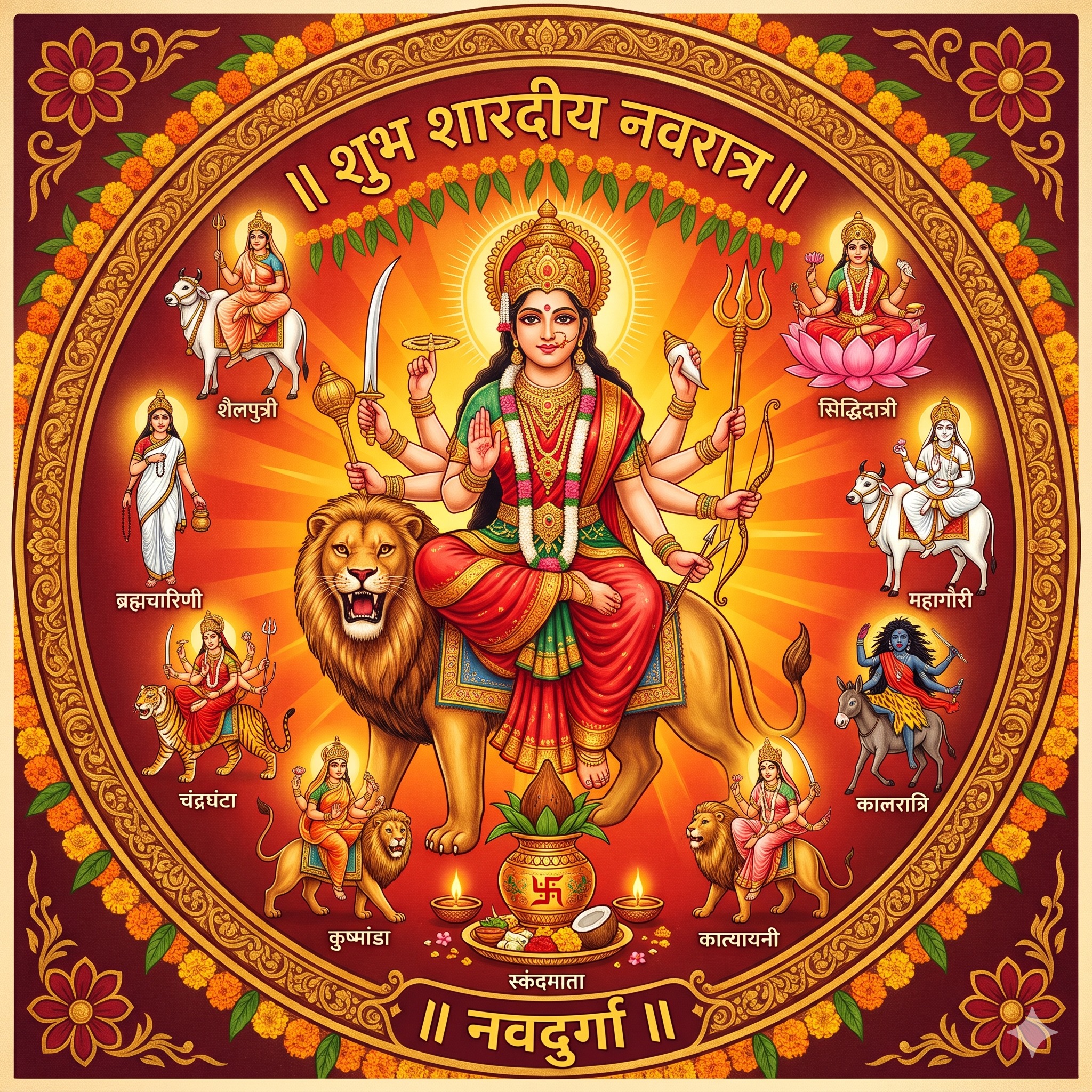
Shardiya Navaratri begins on the Pratipada of Ashwina's bright fortnight: for nine nights, from the Pratipada to the Navami, Goddess Durga is worshipped.

इस दिनKept on Friday 17 October, when Pratipada holds the sunrise.

समयthe day's timings, Delhi

शारदीय नवरात्र आरम्भShardiya Navaratri Begins
06:23 – 10:23शुक्रवार प्रातः ६:२३ – १०:२३ · morning (Pratah)
In the morning (प्रातःकाल) the kalasha (कलश) is set, never at night: within the ten ghatikas (four hours) after sunrise while the Pratipada runs, from the Pratipada's start when it begins after sunrise; if the Pratipada begins only after them, at midday in the Abhijit muhurta (अभिजित् मुहूर्त), never in the afternoon. Within those hours the Pratipada's first sixteen ghatikas and the hours of the Chitra star (चित्रा) and the Vaidhriti yoga (वैधृति) are kept out where they can be. Where two of them together would leave no hour, each is kept out by itself and the hour that remains is used; where they fill the whole morning, the kalasha is set in it all the same.
प्रतिपदाPratipada
Thu 13:50 → Fri 12:59गुरुवार १:५० से शुक्रवार १२:५९ तक
It holds Friday's sunrise (06:23); Thursday's sunrise (06:22) came before it began.
चन्द्रोदयmoonrise
07:14७:१४
Sunrise 06:23, sunset 17:50; the next sunrise 06:23. Then: Saturday 18 Tula Sankranti.

श्लोकfrom the scriptures

निर्णयwhy this is the day

Pratipada begins at 13:50 on Thursday (१:५०) and runs until 12:59 on Friday (१२:५९). It holds Friday's sunrise (06:23); Thursday's sunrise (06:22) came before it began, so Friday is the day.

नियम पूरा · the rule in full

Ashwina Shukla Pratipada: the day the tithi holds sunrise and longest after it — three muhurtas, else two, else one; on two equal days, the second; when no sunrise holds it for a muhurta, the day it begins, even joined with the Amavasya.

अन्य परम्पराother traditions

Some traditions never begin the nine nights on a Pratipada still joined with the Amavasya, even when it alone holds the sunrise. They open the nine nights on the Pratipada joined to the Dwitiya, even if it lasts only one muhurta (मुहूर्त) after sunrise. Where the Pratipada holds two sunrises, they keep the second. Some traditions avoid only the first part of the Chitra star or the Vaidhriti yoga: they leave its first two quarters (चरण) and set the kalasha after them. Where the whole Pratipada lies under them, they leave its first three parts and worship in the fourth. Some traditions, when the Chitra star or the Vaidhriti yoga holds the whole morning, set the kalasha in the Abhijit muhurta (अभिजित् मुहूर्त) at midday instead.

विधिhow it is done

  1. In the morning, after the oil bath (अभ्यंगस्नान), take the vow (संकल्प) for the nine nights' worship of Goddess Durga.
  2. The vow asks the Goddess's grace for peace from every trouble, long life, wealth, children and grandchildren, lasting prosperity (लक्ष्मी), fame and victory over every foe.
  3. Worship Lord Ganesha (गणपति) first, then the Matrikas (मातृका), the guardians of the directions (लोकपाल), the nine planets (नवग्रह) and Varuna (वरुण).
  4. Make an altar (वेदी) of clean earth, sow barley (जौ) and wheat (गेहूँ) on it, and set the kalasha (कलश) of gold, silver, copper or clay upon the altar.
  5. Set the image (प्रतिमा) of the Goddess on the kalasha (कलश) with the consecration (प्रतिष्ठा).
  6. Her image may be of gold, silver, copper, clay or stone, or a painted one; one of raw clay, paper or sindoor (सिन्दूर), which the bath would spoil, is covered with glass.
  7. If you have no image, draw a svastika (स्वस्तिक) behind the kalasha with a trident (त्रिशूल) on each side; set there Goddess Durga's picture, the book of the Durga Saptashati (दुर्गा सप्तशती) and the Shalagrama (शालग्राम), and worship Lord Vishnu.
  8. Invite the Goddess into the kalasha and her image with the invitation (आवाहन) and her verse (the third leaf).
  9. Worship her with the sixteen offerings (षोडशोपचार), offering milk (दूध) and ghee (घी), with the verse of her names (the second leaf) or her nine-syllable mantra "ॐ दुर्गे दुर्गे रक्षिणि स्वाहा".the invitation (आवाहन) · the seat (आसन) · water for the feet (पाद्य) · water for the hands (अर्घ्य) · water to sip (आचमन) · the bath (स्नान) · clothes (वस्त्र) · the sacred thread (यज्ञोपवीत) · sandal paste (गन्ध) · flowers (पुष्प) · incense (धूप) · the lamp (दीप) · food (नैवेद्य) · betel (ताम्बूल) · the gift (दक्षिणा) · pradakshina and pranam (प्रदक्षिणा-नमस्कार)
  10. On this Pratipada offer the Goddess amla (आँवला), fragrant oil and the other things of her adornment (प्रसाधन).
  11. Light the unbroken lamp (अखण्डदीप) with its verse (the fifth leaf) and keep the lamp burning day and night through the nine nights.
  12. Worship the Goddess every day of the nine nights, in the morning (प्रातःकाल), at midday (मध्याह्न) and at dusk (प्रदोष), or twice or once as you are able, and read the Durga Saptashati (दुर्गा सप्तशती).
  13. Before reading, worship the book with the five offerings (पंचोपचार), saying "नमो देव्यै महादेव्यै शिवायै सततं नमः । नमः प्रकृत्यै भद्रायै नियताः प्रणताः स्म ताम् ॥" (Salutation always to the Goddess, the great Goddess, the auspicious one; salutation to her who is Nature (प्रकृति), the gracious one: with devoted hearts we bow to her.)
  14. Set the book on a stand (आधार), not in your hand. Pause only at the end of a chapter; if you stop midway, begin that chapter again. Read clearly, neither too fast nor too slow, with your mind on its meaning.
  15. Keep the vrata (व्रत) as your strength and family custom allow: all nine nights, or seven from the Tritiya, five from the Panchami, three from the Saptami or two from the Ashtami.
  16. Which of these acts a house keeps, and how many, follows its own custom (कुलाचार); a fast vowed for a wish may be kept even where the family has never kept it.
  17. Where the vrata (व्रत) is kept for one day only, keep it on the Ashtami or the Navami alone.
  18. In a year when a tithi is lost, as the Pratipada is in 2027, the lost day's worship is done twice; some keep only eight worships and eight readings, and that carries no fault (दोष).
  19. Keep the fast (उपवास), or take one meal at night (नक्त) or one meal a day (एकभक्त), or eat only what comes to you unasked (अयाचित), or take water alone; sleep on the ground through the nine nights.
  20. Wash the feet of nine young girls (कुमारी) of two to ten years and worship them with sandal paste (गन्ध) and flowers (पुष्प) as the Goddess herself. Offer them sweets with respect and give them clothes (वस्त्र): every day if you are able, else on the last day.
  21. The worship of one girl brings prosperity (ऐश्वर्य), of two enjoyment and liberation, of three dharma, wealth and desire, of four a royal place, and of five learning. Of six it brings success in the six rites, of seven a kingdom, of eight wealth, and of nine rule over the earth.
  22. Offer food to married women (सुवासिनी), as your family's custom asks.

ॐ देवी शैलपुत्र्यै नमः

कथाthe story

Shardiya Navaratri begins on the Pratipada of Ashwina's bright fortnight: for nine nights, from the Pratipada to the Navami, Goddess Durga is worshipped. On this first morning the Goddess is invited into the kalasha (कलश). The worship of Goddess Mahakali (महाकाली), Goddess Mahalakshmi (महालक्ष्मी) and Goddess Mahasaraswati (महासरस्वती) and the reading of the Durga Saptashati (दुर्गा सप्तशती) are the chief worship of the nine nights. It is read and the vow is kept with restraint (संयम): the purer one stays, within and without, the greater the fruit of the nine nights. Whoever reads or hears it with devotion, the Goddess promises, is freed from every danger: in the forest, surrounded by fire, among robbers or in the hands of enemies.

On the Dashami the Goddess is given her farewell (विसर्जन), and the vow is completed. Of the year's Navaratris two are the chief: the spring one (वासन्तिक) and this autumn one (शारदीय). In spring the worship of Lord Vishnu comes first, and in autumn the worship of the Goddess (शक्ति). Yet both are great, and in both it is fitting to worship the Lord and the Goddess together. Worshipped in Ashwina's bright fortnight, Goddess Durga grants all four aims of life (चतुर्वर्ग): dharma, wealth, the fulfilment of desire and liberation. To those who keep this autumn worship with devotion she gives a wife, wealth, health and progress, and to those who worship her seeking nothing, she gives herself.

व्रत कथा · the full katha will open here.

आसपास के दिनthe days around

अन्य वर्षother years, Delhi

२०२९ 2029Mon 8 Oct२०३० 2030Sat 28 Sep२०३१ 2031Fri 17 Oct२०३२ 2032२०३३ 2033

कौन · कहाँwho · where

Everyone, of every community; the worshippers of Goddess Durga above all. This worship is offered pure (सात्त्विक), with japa (जप), homa (होम) and offerings of grain, never with meat or liquor; those who do not recite its mantras themselves hear the Durga Saptashati (दुर्गा सप्तशती) or have it recited for them. In Bengal the great worship of the Goddess begins on the Shashthi, and the vow is kept from the Shashthi to the Navami. In Mithila and across the rest of the land the nine nights open on the Pratipada. Worshipped: Ma Durga.