द्वितीया शनिवार ६:२२ से रविवार ८:५१ तकDwitiya from Saturday 06:22 to Sunday 08:51 · Delhi
तृतीयाद्वितीया until 08:51Jagannath Rath Yatra before dawn
जगन्नाथ रथ यात्रा
Jagannath Rath Yatra
२२22जून २०३१ · June 2031 रविवार · Sunday
Jagannath Rath Yatra is Lord Jagannath's chariot festival (रथयात्रा), kept all over India on the Dwitiya of Ashadha's bright fortnight, above all at Puri.
इस दिनKept on Sunday 22 June, when Dwitiya holds the forenoon hour (Purvahna).
On the Dwitiya (द्वितीया) of Ashadha's bright fortnight joined with the Pushya star (पुष्य), one should seat Lord Balarama (राम) and Goddess Subhadra (भद्रा) on the chariot (रथ), begin the festival of the yatra (यात्रोत्सव) and honour many brahmanas. When the star is absent, this yatra of the Lord's, which gives merit (पुण्यदा), is kept on the tithi alone.
पुष्यनक्षत्र से युक्त, आषाढशुक्ल द्वितीया को देवी सुभद्रासहित भगवान् बलराम को रथ में बैठाकर यात्रा का उत्सव करना चाहिये और बहुत से ब्राह्मणों को प्रसन्न करे। पुष्यनक्षत्र न हो तो भगवान् की यह पुण्य देनेवाली रथयात्रा तिथि में ही करनी चाहिये।
श्री२
the promise of the day — the darshan of the three on their chariots
On this day, whoever sees Lord Purushottama (पुरुषोत्तम) seated on his chariot (रथस्थ) on the way to the great altar (महावेदी), with Lord Balabhadra (बलभद्र) and Goddess Subhadra (सुभद्रा), is surely set free (मुक्ति).
इस दिन रथ में स्थित हो महावेदी की ओर जाते हुए भगवान् पुरुषोत्तम, बलभद्र जी और सुभद्रा जी का दर्शन करके मनुष्य को निश्चय ही मुक्ति मिल जाती है।
निर्णयwhy this is the day
Dwitiya begins at 06:22 on Saturday (६:२२) and runs until 08:51 on Sunday (८:५१). It covers Sunday's forenoon hour, 05:24 to 10:03, so Sunday is the day. This year the Pushya star (पुष्य) does not join the Dwitiya, so Jagannath Rath Yatra is kept on the Dwitiya alone.
नियम पूरा · the rule in full
Ashadha Shukla Dwitiya: the day the tithi covers Purvahna; when it does so on two days, the second; special when the Pushya star joins the tithi, and kept on the tithi alone when the star is absent.
विधिhow it is done
At dawn (अरुणोदय), worship Lord Jagannath before he sets out on the chariot (रथ).
Then, with the brahmanas, the Vaishnavas (वैष्णव), the ascetics (तपस्वी) and the sannyasis (यति), pray to the Lord with folded hands to set out on his journey of victory (विजय-यात्रा) to the Gundicha temple.
As the Lord sets out to music (वाद्य), sing auspicious songs (मङ्गलगीत), raise the cry of victory (जय-जयकार) and chant aloud (उच्च स्वर) the mantra that begins "जितं ते पुण्डरीकाक्ष" (Victory is yours, O lotus-eyed Lord). हे कमलनयन भगवान्! आपकी जय हो।
Take darshan (दर्शन) of the Lord on his chariot and walk with it, singing his names and calling out "Jaya Krishna, Jaya Krishna, Jaya Krishna" (जय कृष्ण): whoever does so is never born again.
Stand before the chariot and fan the Lord with the whisk (चँवर), a fan (व्यजन), a bunch of flowers or a cloth: whoever does so reaches the world of Lord Brahma (ब्रह्मलोक) and attains liberation (मोक्ष).
Go round the chariot in pradakshina (प्रदक्षिणा) while reciting his thousand names (सहस्रनाम): those who do so become like Lord Vishnu and dwell in Vaikuntha (वैकुण्ठधाम).
Give dana (दान) in his name: even a small gift bears undying fruit (अक्षय फल), like the gift of Mount Meru (मेरुदान).
Bow to the Lord in full prostration (साष्टाङ्ग प्रणाम) on the chariot's road, even where the rain has turned it to mud (कीचड़): those who do so are freed from the sins of all their past.
Praise the Lord calling "Jaya" (जय), and dance and sing before him: those who do so overcome their sins and, in the company of his devotees, attain liberation (मोक्ष).
Honour many brahmanas with the Lord's prasad (प्रसाद) and with dakshina (दक्षिणा).
If you cannot come to Puri, seat a picture (चित्र) of the Lord on a chariot at home and keep the yatra with devotion.
Each morning read the account of the yatra, or listen to it with care: whoever keeps the yatra so at home also reaches Vaikuntha (वैकुण्ठधाम), by Lord Vishnu's grace.
For the Lord's seven days at the Gundicha temple, keep his vrata (व्रत): bathe three times a day in silence (मौन), and worship him on the kalasha (कलश) at dawn, noon and dusk.
Light a lamp (दीप) of cow's ghee (घी) or sesame (तिल) oil before him and keep it lit day and night; keep silence by day, and by night keep a vigil (जागरण) chanting his mantra.
On the eighth morning, rise and have the pratishtha (प्रतिष्ठा) performed: whoever keeps this king of vratas fully gains dharma, artha, kama and moksha (मोक्ष), as each one wishes.
ॐ जगन्नाथाय नमःOm Jagannathaya Namah
कथाthe story
Jagannath Rath Yatra is Lord Jagannath's chariot festival (रथयात्रा), kept all over India on the Dwitiya of Ashadha's bright fortnight, above all at Puri. Of Lord Jagannath's twelve yatras (द्वादश यात्रा), the Gundicha yatra is the chief. The day is also called the Gundicha Mahotsava (गुण्डिचा-महोत्सव), after the Gundicha temple (गुण्डिचा-मन्दिर) to which the Lord goes. In this temple Lord Vishwakarma made the wooden images (दारुप्रतिमा) of Lord Jagannath, Lord Balabhadra and Goddess Subhadra, and King Indradyumna performed their consecration (प्रतिष्ठा). The Lord holds this place of his birth (जन्मस्थान) very dear, and he once told King Indradyumna that he would go there every year. It is also held that the yatra fulfils Goddess Subhadra's wish to go through the city (नगर-भ्रमण) with her two brothers, Lord Jagannath and Lord Balabhadra. The Lord, most compassionate and the protector of his devotees, sets out every year so that faith may wake even in those who have none. The road is made ready with flowers (पुष्प), garlands (माला), flags (पताका) and incense (धूप).
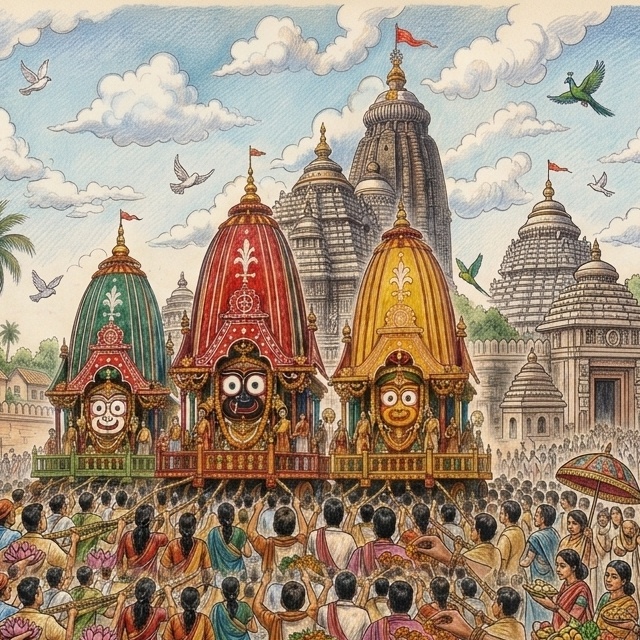
Lord Jagannath, Lord Balabhadra and Goddess Subhadra are carried to their three chariots (रथ), seated beneath canopies (चँदोवा), adorned and worshipped. Then the chariots set out for the Gundicha temple. Whoever takes the Lord's darshan (दर्शन) on his chariot with devotion is promised a place in his own abode (धाम). At the Gundicha temple the Lord stays seven days on the bank of the Bindu tirtha (बिन्दुतीर्थ), by a boon he gave the king long ago. While he stays there, all the tirthas (तीर्थ) come to dwell in it. Whoever bathes in it and takes darshan (दर्शन) of Lord Jagannath, Lord Balabhadra and Goddess Subhadra there for those seven days attains oneness with him (सायुज्य). On the eighth day the chariots are turned to face south. On the Navami of the same bright fortnight, Lord Jagannath, Lord Balabhadra and Goddess Subhadra are seated on their chariots again for the journey back. So the whole yatra lasts nine days.
All devotees of Lord Jagannath: those who come to Puri for his darshan (दर्शन), and those who keep his yatra at home. Puri in Odisha, where the chariots go from the Lord's great temple to the Gundicha temple (गुण्डिचा-मन्दिर). There Lord Balabhadra's chariot is Taladhvaja (तालध्वज), Goddess Subhadra's is Devadalana (देवदलन) and Lord Jagannath's is Nandighosha (नन्दीघोष). Lord Jagannath, Lord Balabhadra and Goddess Subhadra come to their chariots one by one from the jewelled altar (रत्नवेदी), in the swaying procession called Pahandi (पहण्डी). Before the chariots are drawn, the king of Puri, as the Lord's first servant, sweeps them with a golden broom: the Chhera Panhara (छेरा-पंहरा). Then thousands of devotees draw the chariots along the Bada Danda (बड़दाण्ड) to the Gundicha temple, which they reach by evening. Only on the chariot do devotees have the blessing of touching the Lord as they take his darshan (दर्शन). In Ayodhya Lord Rama's chariot festival (रथयात्रा) is kept on this day, like Lord Jagannath's. Saints and devotees gather in great numbers on the bank of the Sarayu (सरयू). In Kashi the fair (मेला) of Lord Jagannath's chariot festival runs from the Dwitiya to the Chaturthi. In Braj, on this day, the Lord (ठाकुरजी) is seated in his chariot. In Vrindavan the chariots of many temples, bearing Lord Jagannath's wooden images (दारुविग्रह), come to the Gyan Gudri (ज्ञानगूदड़ी) and go round it in parikrama (परिक्रमा). In Nathdwara a silver chariot (रजत-रथ) is set before Shrinathji (श्रीनाथजी) on this day, with an offering (भोग) of a hundred and twenty-five thousand mangoes (सवा लाख आम). In Bengal devotees draw the Lord's adorned chariot amid fairs (मेला); the Lord goes to the house of his mother's sister (मौसी) and stays there a week. In Manipur Lord Jagannath's chariot goes in procession (परिभ्रमण) on this day, and men and women dance the clapping dance (ताली-नृत्य) to songs of Radha's wedding (राधा-विवाह). In Alwar, Rajasthan, a former ruler brought the images of Lord Jagannath, Goddess Subhadra and Lord Balabhadra from Puri. There the chariot festival goes out on the Navami of Ashadha's bright fortnight and goes round the city to another temple. Lord Jagannath's wedding (विवाह) is kept there on the Ekadashi, and two days later the three return to their own temple. Worshipped: Lord Jagannath, Lord Balarama and Goddess Subhadra.