अष्टमीसप्तमी until 14:13Makara Sankranti in the holy hourthe Sun enters Makara Thursday 21:10, before this day's sunrise
मकर संक्रान्ति
Makara Sankranti
१५15जनवरी २०२७ · January 2027 शुक्रवार · Friday
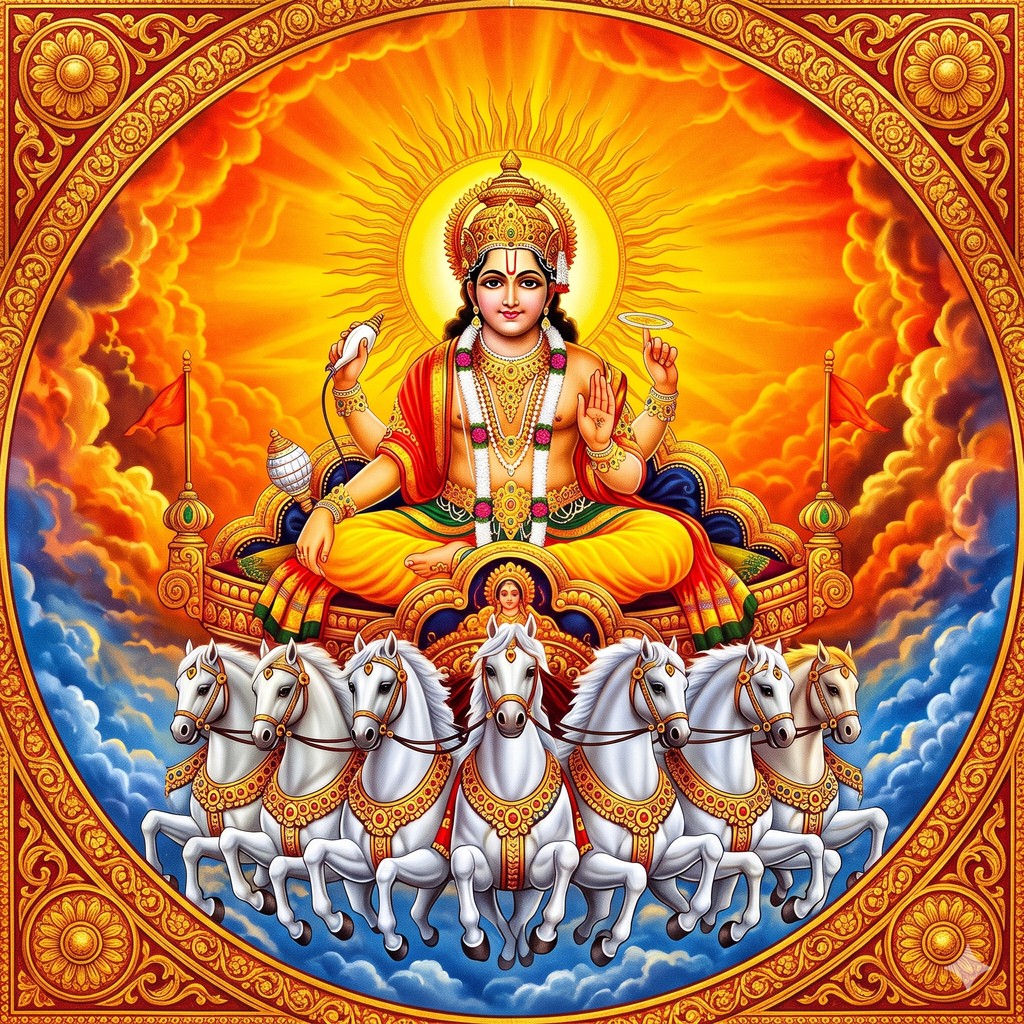
The day the Sun enters Makara and turns to his northern course, Uttarayana (उत्तरायण): kept across the whole country under more than a dozen names, as the day from which the light begins to grow.
इस दिनKept on Friday 15 January, the morning after the Sun enters Makara (Thursday 21:10), in the holy hour from sunrise.
The Sun's entry opens the holy hour (पुण्यकाल): the forty ghatis — sixteen hours — after it. When the Sun enters at night, the next day is kept: its first half, to midday, is the holier, and the five ghatis after sunrise the holiest.
सप्तमीSaptami
Thu 13:59 → Fri 14:13गुरुवार १:५९ से शुक्रवार २:१३ तक
Saptami begins at 13:59 on Thursday (१:५९) and runs until 14:13 on Friday (२:१३).
The holy hour is the first half of the next day: on Friday from sunrise, 07:15 to 12:31, and the five ghatis after sunrise (07:15 to 09:15) are the holiest.
गुरु गोबिंद सिंह जयन्तीGuru Gobind Singh Jayanti · Prakash Parv
07:15शुक्रवार सूर्योदय ७:१५ · at sunrise
माघ बिहूMagh Bihu
07:15शुक्रवार सूर्योदय ७:१५ · at sunrise
The Uruka feast is through the night (रात्रि); on Magh Bihu the bath is taken before dawn (भोर) and the Meji lit after it.
मकरविलक्कुMakaravilakku
07:15शुक्रवार सूर्योदय ७:१५ · at sunrise
Makaravilakku is the great evening of the Sabarimala pilgrimage, kept on the day the Sun enters Makara.
चन्द्रोदयmoonrise
11:21११:२१
Sunrise 07:15, sunset 17:46; the next sunrise 07:15. Then: Saturday 16 Mattu Pongal, Monday 18 Pausha Putrada Ekadashi.
श्लोकfrom the scriptures
श्री१
the rule of the day — when the Sun enters Makara at night
अयने तु मकरे रात्रिसंक्रमे सर्वत्र परदिनमेव पुण्यम् ॥
At the ayana (अयन) of Makara, when the Sun's entry (संक्रम) falls at night, everywhere the next day (परदिन) alone is the holy day (पुण्य).
श्री२
the rule's one exception — an entry in the evening twilight
The three ghatis (घटिका) after sunset (सूर्यास्त) are the evening twilight (सायंसंध्या); when the Sun enters Makara within them, the holy day is the earlier day (पूर्वदिन).
So the bath (स्नान) is kept by every one: the verse reminds us, gently, that to let the Sun's entry (रविसंक्रमण) pass without bathing is a loss felt through many births (सप्तजन्म), in health and in means — and the bath is the whole remedy.
Whatever the givers offer at the sankranti (संक्रान्ति) to the gods (हव्य) and to the ancestors (कव्य), the Sun (अर्क) gives back to them for ever, birth after birth (जन्मनि जन्मनि).
O king, at the Uttarayana (उत्तरायण) give a cow made of sesame (तिलमयी धेनु); offer fair lamps (दीप) of sesame oil in Lord Shiva's temple; worship Lord Shiva duly with sesame and rice (तण्डुल); on this day bathe with black sesame (कृष्णतिल) and rub the body with sesame (उद्वर्तन); and at the Uttarayana sesame is to be given (देय), offered into the fire (होतव्य) and eaten (भक्ष्य).
From the Sun's (भानु) entry into Makara (मकरसंक्रान्ति), six months (षण्मास) are the northern course, Uttarayana (उत्तरायण); from the Sun's entry into Karka, likewise, six months are the southern, Dakshinayana (दक्षिणायन).
श्री७
the gift of ghee and a blanket — the verse names the month of Magha, which by the Sun's count begins with this day
माघे मासि महादेव यो दद्याद् घृतकम्बलम् । स भुक्त्वा सकलान् भोगान् अन्ते मोक्षं च विन्दति ॥
O Mahadeva (महादेव), whoever gives ghee and a blanket (घृतकम्बल) in the month of Magha (माघ) enjoys every blessing (भोग) and at the end attains liberation (मोक्ष).
श्री८
the arghya (अर्घ्य) to the Sun, said each morning through the bath of Magha that may begin today
To Savitri (सवित्रि), to Prasavitri (प्रसवित्रि), the supreme abode (परंधाम), in this water of mine: by your radiance (तेजस्) may my sin (पाप), struck off, go in a thousand pieces (सहस्रधा).
निर्णयwhy this is the day
The Sun enters Makara on Thursday 14 January at 21:10 (Delhi). The entry falls at night, after the evening twilight — the three ghatis after sunset (17:45 to 18:57), so the day is the morning after, Friday. The holy hour is the first half of the next day: on Friday from sunrise, 07:15 to 12:31, and the five ghatis after sunrise (07:15 to 09:15) are the holiest.
नियम पूरा · the rule in full
The day of the Sun's entry into Makara: the civil day of the ingress when it falls in daylight or within three ghatis after sunset, otherwise the morning after the night that holds it. The holy hour is the 40 ghatikas (16 hours) after the entry; the acts are kept by day — an entry at night gives the next morning, its first half and the five ghatikas after sunrise the holiest.
अन्य परम्पराother traditions
Three readings of the day are kept. One counts the day from midnight: the festival falls on the civil date of the Sun's entry, and only an entry after midnight carries it to the next date — so when the Sun enters in the evening, this reading keeps the date of the entry itself. One holds that an entry at sunset, in the first part of the night or at midnight makes both days holy, and the bath and the gift may be kept on either. One, kept in the south, gives every night entry to the morning after, with the five ghatis after sunrise the holiest hour; and by the Tamil reckoning the month of Thai, and with it Pongal, begins on the day of the entry when the Sun enters before sunset, and on the next day when the Sun enters after it.
विधिhow it is done
Take the bath (स्नान) in the holy hour (पुण्यकाल) — when the Sun enters by night, in the morning after, the five ghatis after sunrise being the holiest — in the Ganga or a tirtha if you can. First rub the body with sesame (तिल), and bathe with black sesame in the water.
Offer tarpana (तर्पण) with sesame: white sesame to the gods, black sesame to the ancestors.
Those who offer shraddha (श्राद्ध) for their departed offer it today, without the pinda (पिण्ड): on this day of the ayana it is not left out.
Bathe the image (प्रतिमा) of the Sun with milk. Worship Lord Shiva with sesame and rice, offer the lamp (दीप) of sesame oil in his temple, and, if you can, the abhisheka (अभिषेक) with ghee.
Make the day's dana (दान): sesame and jaggery, khichdi (खिचड़ी), cloth, ghee and a blanket, firewood and fire. A gift made today returns a hundredfold.
Offer sesame into the fire, and eat sesame — with jaggery (गुड़), and as khichdi; share sesame sweets with good wishes.
Keep the fast (उपवास) if you choose — three nights or one night before the entry, ending on the day that holds the entry or the holy hour; it is not for a householder with children. For those who keep the month-long bath of Magha, it may begin today.
सवित्रे प्रसवित्रे च परंधामजले मम ॥ त्वत्तेजसा परिभ्रष्टं पापं यातु सहस्रधा ॥Savitre Prasavitre Cha Paramdhamajale Mama, Tvattejasa Paribhrashtam Papam Yatu Sahasradha
कथाthe story
The day the Sun enters Makara and turns to his northern course, Uttarayana (उत्तरायण): kept across the whole country under more than a dozen names, as the day from which the light begins to grow. The scriptures call the six months of Uttarayana the day of the gods and the six months of Dakshinayana (दक्षिणायन) their night, so Makara Sankranti is the dawn of the gods; from it the days lengthen and the nights shorten, a turn from darkness toward light. The bath (स्नान) on this day is for every one, in a holy river if one can: at Prayag, where all the gods are said to come to the confluence to bathe, and at Gangasagar, where Goddess Ganga, coming down from heaven behind Bhagiratha, met the sea at the ashram of the sage Kapila and freed the sixty thousand sons of King Sagara.
A gift (दान) made on this day is said to return a hundredfold, and what is given to the gods and the ancestors at a sankranti the Sun gives back, birth after birth. Sesame (तिल) is the day's own offering — rubbed on the body, bathed with, offered into the fire, given and eaten — and sesame and jaggery are shared with good wishes, for from this day, it is said, the Sun's course grows by a sesame-grain a day. In Uttar Pradesh the day is Khichdi, in the south Pongal, in Assam Magh Bihu, in Punjab Lohri on its eve and Maghi the day after, in Kumaon Uttarayani.
Every one — the bath is for all; shraddha for those who offer it for their departed; the fast for those who choose it and have no children at home; the gifts by every household. Kept across the whole country. In Uttar Pradesh the day is Khichdi: khichdi is eaten and given with sesame. In Bengal the bath and the gift of sesame, and the bath at Gangasagar, the most famous fair of the day. At Prayag the Magha fair opens at the confluence and runs a month, with its kalpavasa. In Maharashtra married women give oil, cotton and salt at their first sankranti and present one another a plate of thirteen things, and sesame sweets are shared with good wishes; in Maharashtra and Gujarat the day has its sporting contests. In Rajasthan married women set a rupee on sesame laddus and ghevar and give them, bowing, to the mother-in-law, and give fourteen of a kind to fourteen brahmins. In Vraja the bath in the Yamuna, the gift of sesame laddus, rewari and khichdi, and the khichdi festival of Shri Radhavallabh at Vrindavan. In Kashi it is one of the four great solar days, Khichdi. In Kumaon the bath in the holy rivers, a khichdi of black urad given and eaten, and the children's Uttarayani, when at dawn they call the crows to eat. In Assam Magh Bihu, the harvest festival: the Meji fire lit before dawn, the whole village round it praying for the good of all. In Puri the Navanka yatra the day before and the offering of Makara rice. In Tamil Nadu Pongal; in Punjab and Jammu-Kashmir Lohri on the eve and Maghi the day after; among the Sindhis Lal Loi on the eve and Tirmuri on the day. Worshipped: Lord Surya.